
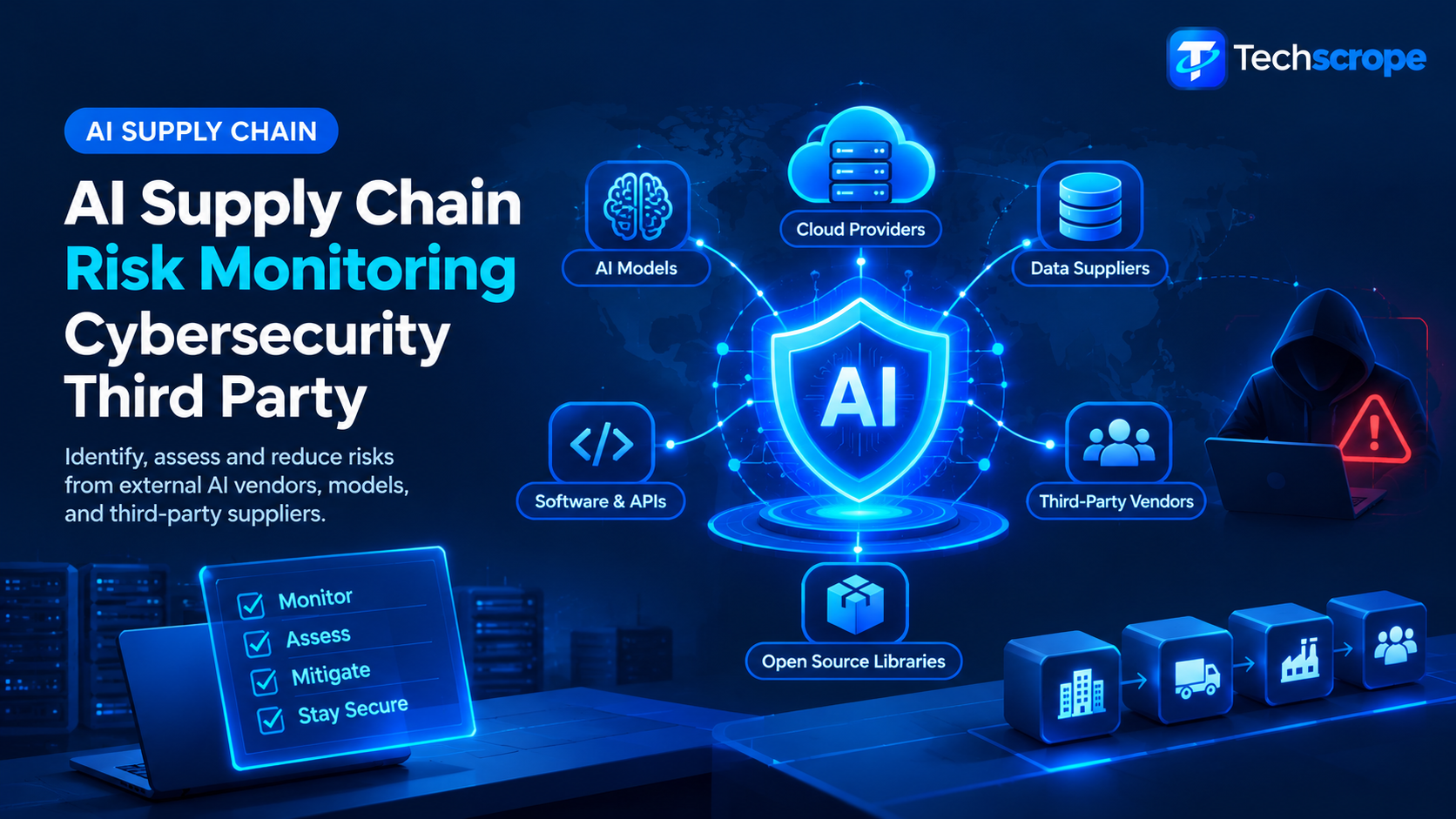
AI supply chain risk monitoring cybersecurity third party practices help organizations identify, assess, and reduce security threats introduced by external AI vendors, software providers, cloud platforms, and data suppliers. As businesses increasingly rely on artificial intelligence, protecting internal systems alone is no longer enough.
An AI application may depend on an external model, a third-party API, cloud infrastructure, open-source libraries, and several data providers. A vulnerability in any one of these components can expose sensitive information, disrupt operations, or compromise business decisions.
Organizations need a proactive approach that combines AI supply chain security, continuous monitoring, vendor assessments, and incident response. This guide explains the major risks, practical monitoring methods, and seven steps businesses can use to build a stronger cybersecurity program.
What Is AI Supply Chain Risk Monitoring?
AI supply chain risk monitoring is the ongoing process of identifying and evaluating security threats across the external components, vendors, data sources, and infrastructure that support AI systems.
Unlike traditional vendor management, AI supply chain monitoring must consider both technical vulnerabilities and risks associated with model behavior, training data, and changes made by external providers.
For example, a company might use an AI-powered customer service tool hosted by a third-party provider. If that provider stores customer conversations insecurely or relies on a compromised software dependency, the company could experience a data breach even if its own network remains secure.
Effective monitoring helps organizations discover these weaknesses before they become serious incidents.
AI Supply Chain Risk vs. Third-Party Model Risk
AI supply chain risk covers the entire ecosystem supporting an AI system, while third-party model risk focuses specifically on models developed or supplied by external organizations.
| Risk category | What it includes |
|---|---|
| AI supply chain risk | Models, datasets, APIs, cloud services, software dependencies, and integrations |
| Third-party model risk | Model integrity, reliability, updates, training-data provenance, and behavior |
| Vendor cybersecurity risk | Access controls, vulnerabilities, data protection, and incident response |
| Fourth-party risk | Security weaknesses in the vendors and subcontractors used by direct suppliers |
These categories overlap, but they are not interchangeable. A complete assessment should examine the model and every important component supporting it.
Why AI Supply Chain Security Matters
AI systems introduce dependencies that can be difficult to inspect. Organizations may not know exactly how a model was trained, which subcontractors process their data, or what changes a provider makes after deployment.
Several factors make AI supply chain security particularly important.
1. Growing Third-Party Dependencies
Businesses frequently connect AI applications to external APIs, cloud platforms, data providers, and software packages. Every connection creates a potential entry point for attackers.
If one provider experiences a security incident, connected applications may inherit the consequences.
2. Limited Visibility Into AI Models
Some AI providers disclose little information about their training datasets, model architecture, security testing, or update processes. This makes independent verification more difficult.
Organizations should request appropriate documentation and evaluate whether the provider offers sufficient transparency for the intended use case.
3. Sensitive Data Exposure
AI tools may process customer records, employee information, financial documents, source code, and confidential business data.
Weak access controls or unclear data-retention policies can expose this information. Businesses should establish rules governing what data can be submitted to external AI services.
4. Rapidly Changing Threats
An AI provider may release a new model version, introduce a new integration, or change its infrastructure after the initial security assessment.
A vendor that was acceptable during onboarding may therefore develop new risks over time. Continuous monitoring helps organizations detect relevant changes and reassess their exposure.
Key Third-Party AI Cybersecurity Risks
Understanding the most common threats helps security teams choose appropriate monitoring controls.
Data Poisoning and Training-Data Manipulation
Data poisoning occurs when malicious or misleading information is introduced into training or fine-tuning data to influence a model’s behavior.
For example, a compromised data supplier might provide manipulated records that cause an AI system to produce unreliable recommendations. Organizations should evaluate data provenance, validation procedures, and the security controls used by their providers.
Compromised Models and Software Dependencies
An attacker may tamper with a model file, compromise a software package, or exploit a vulnerable dependency used by an AI application.
Businesses should verify model sources, scan dependencies, monitor vulnerabilities, and maintain records of approved components. Software bills of materials (SBOMs) can help identify software components and their known vulnerabilities.
Insecure APIs and Cloud Infrastructure
AI applications often exchange information with external APIs and cloud-hosted services. Poor authentication, excessive permissions, or insecure configurations can create opportunities for unauthorized access.
Security teams should monitor API activity, enforce least-privilege access, protect credentials, and review cloud security configurations.
Prompt Injection and AI Data Leakage
Prompt injection attempts to manipulate an AI system through malicious instructions embedded in user input or retrieved content. The risk can increase when an AI application has access to sensitive documents, databases, or external tools.
Controls should include input and output validation, restricted permissions, data-loss prevention, and testing of AI workflows. These measures reduce exposure but cannot eliminate every model-related risk.
Fourth-Party and Hidden Vendor Risks
A direct vendor may depend on its own cloud provider, model supplier, data processor, or software developer. These indirect relationships create fourth-party risk.
Organizations should map critical dependencies and ask vendors to disclose material subcontractors, relevant security incidents, and significant changes to their supply chains.

7 Proven Steps for AI Supply Chain Risk Monitoring Cybersecurity Third Party
A practical monitoring program should combine vendor governance, technical controls, continuous visibility, and a clear response process.
Step 1: Create a Complete AI Vendor Inventory
Begin by identifying every AI system used across the organization, including tools purchased by individual departments.
Record the vendor name, business owner, purpose, data processed, model provider, hosting environment, integrations, and known subcontractors.
Include both officially approved applications and AI tools discovered through security reviews. A complete inventory gives the organization a starting point for identifying unapproved services and hidden dependencies.
Recommended action: Assign an owner to each AI system and update the inventory whenever a new provider, model, or integration is introduced.
Step 2: Conduct a Cybersecurity Supply Chain Risk Assessment
Assess each provider according to the sensitivity of its data, the importance of its service, its technical access, and the potential impact of a compromise.
Review security certifications where relevant, vulnerability management practices, encryption, identity controls, incident history, and data-handling policies. Certifications and questionnaires are useful evidence, but neither guarantees that a provider is secure.
Use a simple scoring model to prioritize vendors.
For example, assign each factor a score from 1 to 5, where 1 represents low risk and 5 represents high risk.
| Assessment factor | Example rating |
|---|---|
| Data sensitivity | 5 |
| System access | 4 |
| Business criticality | 5 |
| Known security weaknesses | 3 |
The average score is 4.25 out of 5, indicating that this example vendor deserves high-priority review.
This is an illustrative model, not a universal risk standard. Organizations should define their own thresholds and escalation rules.
Step 3: Evaluate AI Vendors Before Approval
AI vendor risk management should begin before a product enters production, rather than after a security problem occurs.
Ask vendors questions such as:
-
How is customer data stored, processed, and deleted?
-
Is customer information used to train or improve models?
-
How are models, datasets, and software dependencies verified?
-
How are vulnerabilities discovered and remediated?
-
Which subcontractors can access organizational data?
-
How quickly are customers notified of material security incidents?
-
Can the provider disclose significant model updates or changes in data processing?
Request evidence that supports the answers. Where possible, document the provider’s obligations in contracts and establish a process for reviewing exceptions.
Step 4: Implement Continuous Monitoring
Traditional vendor questionnaires provide a snapshot of a provider’s security posture. Continuous monitoring helps identify changes that occur after onboarding.
Depending on the provider and available integrations, monitoring can include:
-
New vulnerabilities affecting software dependencies.
-
Changes in exposed services or cloud configurations.
-
Suspicious API requests and authentication activity.
-
Changes to model versions or critical integrations.
-
Security advisories and relevant incident disclosures.
-
Expired certifications or overdue remediation commitments.
Not every signal will be available for every vendor. Organizations should prioritize the highest-impact risks and use a combination of provider disclosures, external intelligence, security tools, and contractual reporting.
Step 5: Use AI-Powered Threat Detection
AI-powered threat detection can help security teams analyze large volumes of events, identify unusual behavior, and prioritize potentially serious incidents.
For example, a detection system may flag an unusual increase in API requests, unexpected access to sensitive data, or behavior that differs from an established baseline.
However, AI detection tools can generate false positives and miss certain attacks. Their outputs should be validated against reliable evidence, and high-impact actions should follow approved security procedures.
Combine detection capabilities with established controls such as endpoint monitoring, identity security, cloud logging, and incident management.
Step 6: Strengthen Vendor Governance and Access Controls
Third-party cybersecurity risk management requires clear rules about what vendors can access and what they must report.
Apply least-privilege access, use strong authentication, rotate credentials appropriately, and restrict integrations to the resources they need. Separate sensitive workloads where practical and review permissions regularly.
Contracts should address data ownership, security responsibilities, subcontractors, breach notification, audit rights, data deletion, and termination procedures.
Organizations should also establish who can approve a new AI vendor, accept residual risks, and suspend a service when its security posture becomes unacceptable.
Step 7: Prepare for Incidents and Reassess Risk Regularly
Even well-managed vendors can experience security incidents. Organizations should prepare for situations in which a provider is compromised, a model is unexpectedly changed, or a critical dependency develops a serious vulnerability.
A practical response plan should include:
-
Confirm the alert and determine the systems involved.
-
Assess affected data, users, integrations, and business processes.
-
Restrict or suspend risky connections when necessary.
-
Contact the provider and follow established notification procedures.
-
Preserve relevant logs and investigate the impact.
-
Restore trusted components and validate their security.
-
Document lessons learned and update the risk assessment.
Schedule periodic reassessments based on vendor criticality and trigger additional reviews when significant changes occur. This turns risk monitoring into an ongoing process rather than a one-time compliance exercise.
Best Practices for Effective AI Third-Party Risk Management
A monitoring program works best when security, procurement, legal, compliance, and business teams share responsibility.
The following practices help keep the process manageable:
-
Prioritize critical vendors: Focus first on providers that handle sensitive information or support essential operations.
-
Maintain accurate records: Keep vendor inventories, assessments, exceptions, and remediation actions up to date.
-
Verify important claims: Request evidence rather than relying entirely on vendor assurances.
-
Monitor indirect dependencies: Assess important subcontractors and infrastructure providers.
-
Automate repeatable tasks: Use integrations and security platforms to collect alerts, track vulnerabilities, and flag changes.
-
Test incident procedures: Conduct exercises involving a compromised provider or unavailable AI service.
-
Review access regularly: Remove unnecessary permissions and deactivate unused integrations.
Metrics to Measure AI Supply Chain Security
Monitoring performance should be measurable. A small set of useful indicators can help security teams identify weaknesses and track improvement.
| Metric | What it measures |
|---|---|
| AI vendor inventory coverage | Percentage of identified AI systems recorded in the inventory |
| High-risk vendor assessment coverage | Percentage of critical vendors with current assessments |
| Vulnerability remediation time | Time required to resolve identified weaknesses |
| Vendor incident response time | Time taken to acknowledge and address reported incidents |
| Dependency visibility | Percentage of critical systems with documented dependencies |
| Overdue remediation actions | Number of unresolved issues past their agreed deadlines |
Define each metric consistently and establish a baseline before setting improvement targets. A rising number of detected issues does not always indicate worsening security; it may also reflect better visibility.
Challenges and Limitations of AI Supply Chain Monitoring
Monitoring third-party AI systems is not always straightforward.
Limited transparency: Providers may not disclose complete model details, training data, or subcontractor relationships.
Alert fatigue: Continuous monitoring can produce large numbers of low-priority alerts that distract security teams.
Changing dependencies: AI models and supporting services can change quickly, making older assessments less reliable.
Resource constraints: Smaller organizations may lack the staff and tools needed to assess every provider in depth.
Shared responsibility: A vendor may manage the underlying model or infrastructure, but the customer still needs to protect its data, configure integrations securely, and govern how the AI system is used.
The most effective response is risk-based prioritization. Concentrate resources on critical systems, request transparency where it matters most, and use automation to support—not replace—human judgment.
Conclusion
AI supply chain risk monitoring cybersecurity third party practices are essential for organizations that depend on external models, data providers, cloud platforms, and AI-enabled software. Effective protection requires visibility into dependencies, consistent vendor assessments, continuous monitoring, strong access controls, and tested incident response procedures.
By following the seven steps in this guide, businesses can build a more structured approach to AI supply chain security, prioritize their most important exposures, and adapt as their AI environments evolve.
The goal is not to eliminate every risk. It is to identify important weaknesses early, reduce unnecessary exposure, and make informed decisions about the AI systems an organization depends on.
Frequently Asked Questions
What is AI supply chain risk monitoring?
AI supply chain risk monitoring is the ongoing assessment of security threats across AI models, datasets, vendors, APIs, software dependencies, and infrastructure. It helps organizations identify weaknesses and respond before they cause significant harm.
Why is third-party AI risk management important?
Third-party AI risk management is important because external providers can introduce vulnerabilities, expose sensitive data, or disrupt business operations. Monitoring helps organizations understand these dependencies and establish appropriate security controls.
What are the biggest risks in an AI supply chain?
Major risks include data poisoning, compromised models, vulnerable software dependencies, insecure APIs, data leakage, prompt injection, and hidden fourth-party dependencies. The most relevant risks depend on the system’s design and intended use.
How often should organizations assess AI vendors?
Organizations should assess vendors before approval, review critical providers periodically, and reassess them whenever significant security incidents, model changes, or new dependencies arise. Review frequency should reflect the vendor’s criticality and level of exposure.
How does AI-powered threat detection help supply chain security?
AI-powered threat detection can analyze security events and identify unusual patterns that may indicate a compromised vendor or integration. It works best alongside conventional security controls, verified alerts, and established incident response procedures.
What is fourth-party risk in AI cybersecurity?
Fourth-party risk refers to security exposure introduced by the suppliers and subcontractors used by a direct vendor. For example, an AI software provider may rely on an external model host whose security weakness affects the customer’s application.
Which frameworks can help with AI supply chain security?
Organizations can use the NIST Cybersecurity Framework, the NIST AI Risk Management Framework, and relevant software supply chain security guidance from CISA. The appropriate framework depends on the organization’s industry, risk profile, and compliance obligations.
How can small businesses monitor AI supply chain risks?
Small businesses can begin by maintaining an AI vendor inventory, reviewing provider security documentation, restricting data sharing, enabling available security logs, and prioritizing critical vendors. They can expand automation and assessment depth as their resources grow.