

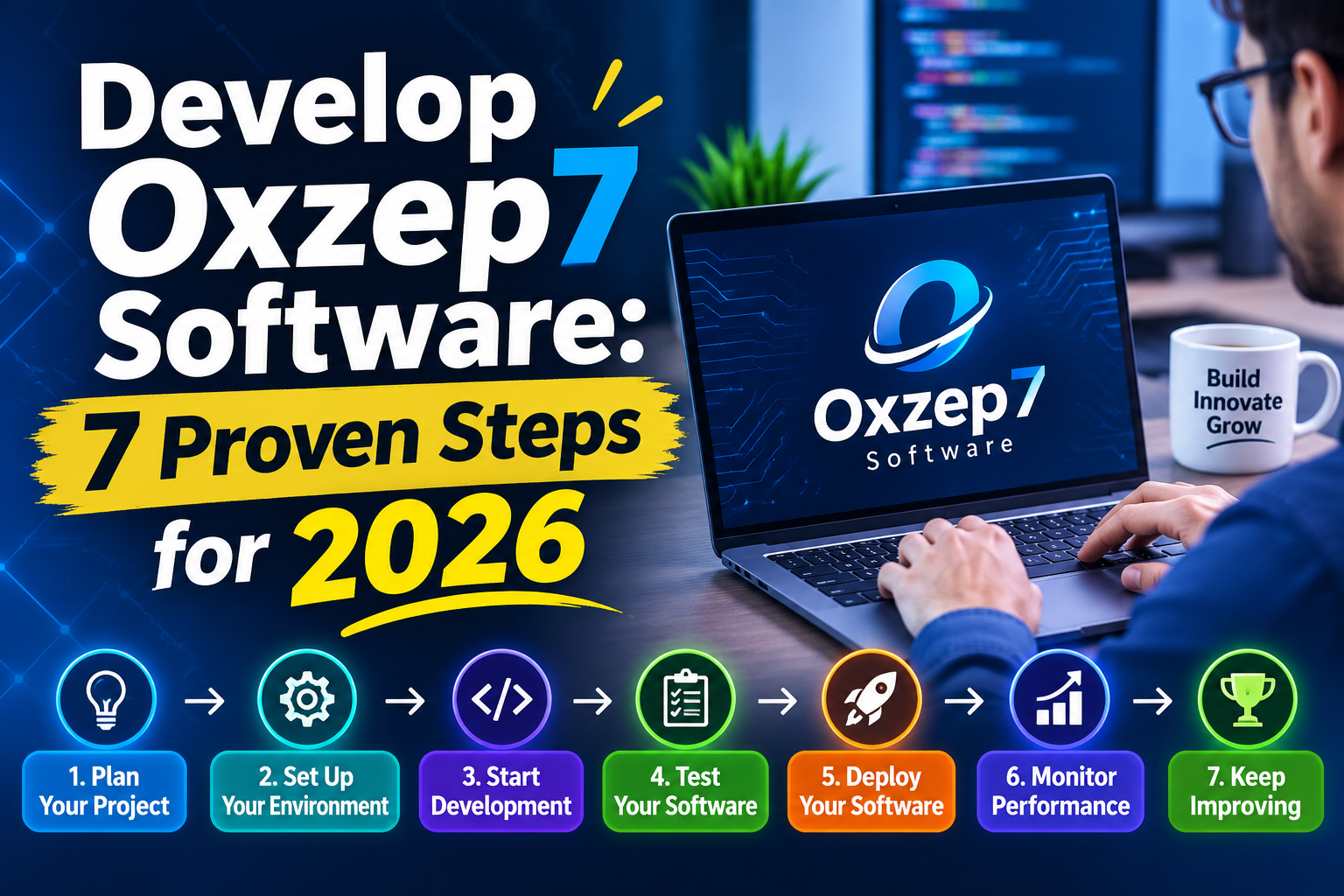
If you want to develop Oxzep7 software, start by finding out what the term actually refers to. Websites describe Oxzep7 as everything from an enterprise framework to a loose development concept.
At the time of writing, we found no official documentation, vendor site, or public repository for it. This Oxzep7 software development guide shows you how to build reliably anyway, using proven tools and a process you can verify.
What Does It Mean to Develop Oxzep7 Software?
To develop Oxzep7 software means to plan, establish, test, and deploy an application that is labelled “Oxzep7”, but the label has no verified standard definition.
Some articles call Oxzep7 a modular, API-first framework with built-in encryption. Others treat it as a general development approach. Very few cite a primary source.
That gap matters. If you follow unverified instructions, you risk wasting weeks or shipping insecure code. The safest approach is to treat “Oxzep7” as a project name and apply the standard software development process described below.
Before you commit, run this quick check:
- Look for official docs, a vendor site, or a maintained repository.
- Check the package registries (PyPI, npm, Maven) for a published library.
- Test any code sample in an isolated environment before using it.
- Be skeptical of statistics that cite no source.
Oxzep7 Software Features: What Is Verified and What Is Not
Most “Oxzep7 software features” listed online are unverified, so judge each claim by its evidence rather than its repetition.
Competing pages repeat the same list of features. The table below separates what you can build yourself from what you should not assume.
| Claimed feature | Reality check | What to do |
| Modular / microservices design | Achievable with any modern stack | Build it yourself with clear service boundaries |
| API-first approach | A design practice, not a product | Use OpenAPI and REST or gRPC |
| Built-in encryption | Not proven for “Oxzep7” | Use vetted libraries and TLS |
| AI and ML integration | Possible through Python libraries | Add it when the use case justifies it |
| HIPAA / PCI DSS / SOC 2 compliance | No framework grants compliance | Plan audits and controls separately |
Compliance in particular belongs to your organisation, your processes, and your auditors. A tool can support it, but it can never guarantee it.
How to Develop Oxzep7 Software: 7 Proven Steps
To develop Oxzep7 software, define your requirements, verify your sources, choose an architecture and stack, build in small modules, test automatically, deploy through CI/CD, and maintain it.
Step 1: Define Scope and Verify Your Sources
Start by writing down the business problem and confirming that every technical claim you rely on has a credible source.
List who will use the software, what it must do, and what success looks like. Record any legal requirements, such as data protection rules.
Then verify each Oxzep7-specific claim. If you cannot find documentation, treat the claim as a hypothesis and move on with standard tools.
Step 2: Gather Requirements and Plan
Good requirements turn a vague idea into a buildable plan with clear priorities.
Split your needs into must-haves and nice-to-haves. Write short user stories, for example: “As an admin, I can export a monthly report.”
Estimate effort in small chunks. Plan for two-week sprints so you get feedback early instead of at the end.
Step 3: Choose the Right Architecture
Pick the simplest architecture that meets your needs, and add complexity only when you have a reason.
A modular monolith suits most small and mid-size teams. It is easier to build, test, and debug than a full microservices setup.
Choose microservices only when teams must deploy independently or parts of the system scale very differently. Whichever you choose, define clear API contracts between components.
Step 4: Select Your Tools and Tech Stack
Choose mature, well-supported tools that your team already understands.
Python with FastAPI is a strong default for APIs and automation. Node.js, Java, and Go are equally valid depending on your team’s skills.
See the next section for a full comparison of software development tools.
Step 5: Build the Core Features in Small Modules
Build the smallest working version first, then expand it in short, reviewed iterations.
Start with one complete user flow, from input to stored result. Use version control, small pull requests, and code reviews from day one.
Here is a minimal Python service to show the pattern. It is a generic example, not an official Oxzep7 SDK:
python
from fastapi import FastAPI
app = FastAPI(title=“Example Service”)
@app.get(“/status”)
def status() -> dict:
return {“status”: “ok”}
Step 6: Test Everything Before Release
Automated tests catch most defects before users do, so write them as you build.
The full approach is covered in the software programming and testing section below.
Step 7: Deploy, Monitor, and Maintain
Deployment is the start of the software’s life, not the end of the project.
Package the app in Docker and deploy through a CI/CD pipeline. Add logging, error tracking, and performance alerts.
Plan regular dependency updates and security patches. Neglected maintenance is one of the most common causes of technical debt.
Software Development Tools for Oxzep7 Projects
The best software development tools are the ones that fit your team, budget, and project size.
You do not need Oxzep7-specific tools to get started. Here is a practical toolkit:
| Purpose | Tool options | Best for |
| Code editing | VS Code, IntelliJ IDEA | Daily development and debugging |
| Version control | Git with GitHub or GitLab | Collaboration and history |
| Backend | Python (FastAPI), Node.js, Java | APIs and business logic |
| Database | PostgreSQL, MongoDB | Relational vs. document data |
| Testing | pytest, Jest, Postman | Unit and API tests |
| CI/CD | GitHub Actions, Jenkins | Automated builds and deploys |
| Containers | Docker, Kubernetes | Consistent deployment and scaling |
| Tracking | Jira, Linear | Sprint planning |
Custom Software Development: Build, Buy, or Hybrid?
Choose custom software development when your process is unique and off-the-shelf tools would force costly workarounds.
Many teams jump to a custom build too early. A quick comparison helps:
- Buy or subscribe when your needs are common, such as invoicing or CRM.
- Build custom when the software is a competitive advantage or no product fits.
- Go hybrid by combining a ready-made platform with custom integrations.
If you decide to develop Oxzep7 software as a custom project, budget for maintenance. A common rule of thumb is that running software costs more over its life than building it.
Software Programming and Testing: Quality From Day One
Strong software programming and testing practices mean writing small, testable units and checking them automatically on every change.
Use the testing pyramid as your guide:
- Unit tests check single functions and run in milliseconds.
- Integration tests confirm that services, databases, and APIs work together.
- End-to-end tests simulate real user journeys, so keep them few.
- Load tests show how the system behaves under heavy traffic.
Here is a simple test for the earlier example:
python
from fastapi.testclient import TestClient
from main import app
client = TestClient(app)
def test_status():
assert client.get(“/status”).json() == {“status”: “ok”}
Run these tests in your CI pipeline so no broken code reaches production. Aim for tests that are fast, reliable, and meaningful rather than chasing a coverage number.
Security Best Practices for Oxzep7 Software Development
Secure development means building protection from the start instead of Secure development means building protection from the start rather than adding it after launch.adding it after launch.
Follow recognised standards rather than unverified claims. The OWASP Top 10 lists the most common web application risks. The NIST Secure Software Development Framework (SP 800-218) outlines secure practices across the whole life cycle.
Apply these basics to every project:
- Validate all input to prevent injection attacks.
- Use strong authentication, such as OAuth2 with short-lived tokens.
- Apply least privilege to users, services, and database accounts.
- Encrypt data in transit with TLS and at rest where needed.
- Scan dependencies automatically for known vulnerabilities.
- Never hard-code secrets; use a secrets manager instead.
Common Mistakes When You Develop Oxzep7 Software
The largest mistakes are trusting unverified guides, over-engineering early, and skipping tests.
Watch for these pitfalls:
- Copying code from unknown sources. Unverified snippets can contain bugs or malicious code.
- Choosing microservices too soon. It adds operational cost before you need it.
- Ignoring documentation. Future developers, including you, will struggle without it.
- Skipping monitoring. You cannot fix what you cannot see.
- Promising compliance. Certifications need audits, not just good tooling.
Oxzep7 Software Development Guide: Final Checklist
Use this checklist to confirm your project is ready to launch.
- Requirements and success metrics are documented
- Every Oxzep7-specific claim has a verified source
- Architecture and API contracts are agreed
- Code is in version control with reviews enabled
- Automated tests run on every commit
- Security scans and dependency checks pass
- Monitoring, logging, and alerts are active
- A maintenance and update plan exists
Conclusion
To develop Oxzep7 software successfully, treat the name as a starting point instead of a specification. Verify claims, choose proven tools, establish in small modules, test automatically, and deploy with monitoring.
This approach works regardless of what Oxzep7 turns out to be. It gives you reliable, secure software and protects you from the risks of unverified advice.
Frequently Asked Questions (FAQ)
What is Oxzep7 software?
Oxzep7 is an unverified term used by several websites, and no official specification or vendor documentation could be found for it.
Some sources describe it as a modular enterprise framework, but those descriptions are not backed by primary sources. Treat it as a project label unless you can confirm otherwise.
How do you develop Oxzep7 software?
You develop Oxzep7 software by defining requirements, verifying sources, choosing a proven stack, building in small modules, testing automatically, and deploying with monitoring.
The seven-step process in this guide applies to any project, whatever the final technology is.
Is Oxzep7 an official software framework?
No official Oxzep7 framework, repository, or vendor documentation could be verified, so framework claims should be treated with caution.
Always look for documentation, a package registry listing, and an active maintainer before depending on any framework.
Which programming language is best for Oxzep7 software development?
Python is a strong default for APIs and automation, but the best language depends on your team’s skills and project requirements.
Java, Node.js, Go, and TypeScript are also solid choices for enterprise and web applications.
How long does it take to develop Oxzep7 software?
A small first version often takes a few weeks to a few months, while complex systems take longer depending on scope, integrations, and team size.
Timelines grow with regulatory requirements, legacy system integration, and unclear requirements. Shipping a minimum viable product first reduces risk.
Can beginners develop Oxzep7 software?
Yes, beginners can follow the general development process using Python, Git, and automated tests, as long as they avoid unverified Oxzep7-specific commands.
Start with a small project, learn version control, and add features step by step.
What tools do I need to develop Oxzep7 software?
You need a code editor, Git, a backend language and database, a testing framework, and a CI/CD pipeline.
Docker helps with consistent deployment. Keep the toolset small and well documented.