

Startup booted is a revenue-first way to build a company: you prove the business on customer money, keep your equity, and raise outside capital only when you can name exactly what it will buy. The term is informal, so founders often confuse it with a consulting website of a similar name.
This guide uses it in the founder sense and turns it into numbers. You will get a 12-month worked example, a tool comparison and a checklist you can use this week.
What Does Startup Booted Mean?
Startup booted has no official definition. In founder conversation, it describes a bootstrapped-first company that treats customer revenue as its main funding source and raises money selectively.
It is not a legal structure, a funding product or a guarantee of success. It is also not the same as any service company with a similar name, so verify who you are dealing with before you pay anyone.
Pure bootstrapping means no outside money at all. A booted company leaves the door open to investors, but on its own timeline and terms.
This approach works best for software, service and online businesses that can reach paying customers quickly. Hardware, biotech and other capital-heavy businesses may need outside money earlier.
Why Startup Financial Planning Comes Before Fundraising
Running out of cash is one of the most common ways early companies fail. A plan that shows your runway protects you from that.
Startup financial planning also gives you leverage. Investors pay more attention to founders who know their churn, margins and payback period than to founders who only have a vision.
Good planning answers three questions:
- How long can we last on current cash?
- Which assumption does our survival depend on?
- What would outside money actually change?
Startup Booted Financial Modeling: The Core Idea
Startup booted financial modeling is a monthly forecast of revenue, costs and cash that shows how long a self-funded company can last and which assumptions matter most.
A venture-style model is built to justify the next round. A booted model is built to keep the company alive and profitable. That changes what you measure.
- Runway matters more than valuation.
- Cash matters more than profit on paper.
- Payback period matters more than top-line growth.
Strong financial models for startups stay simple. A small monthly model that you update beats a complicated one nobody opens.
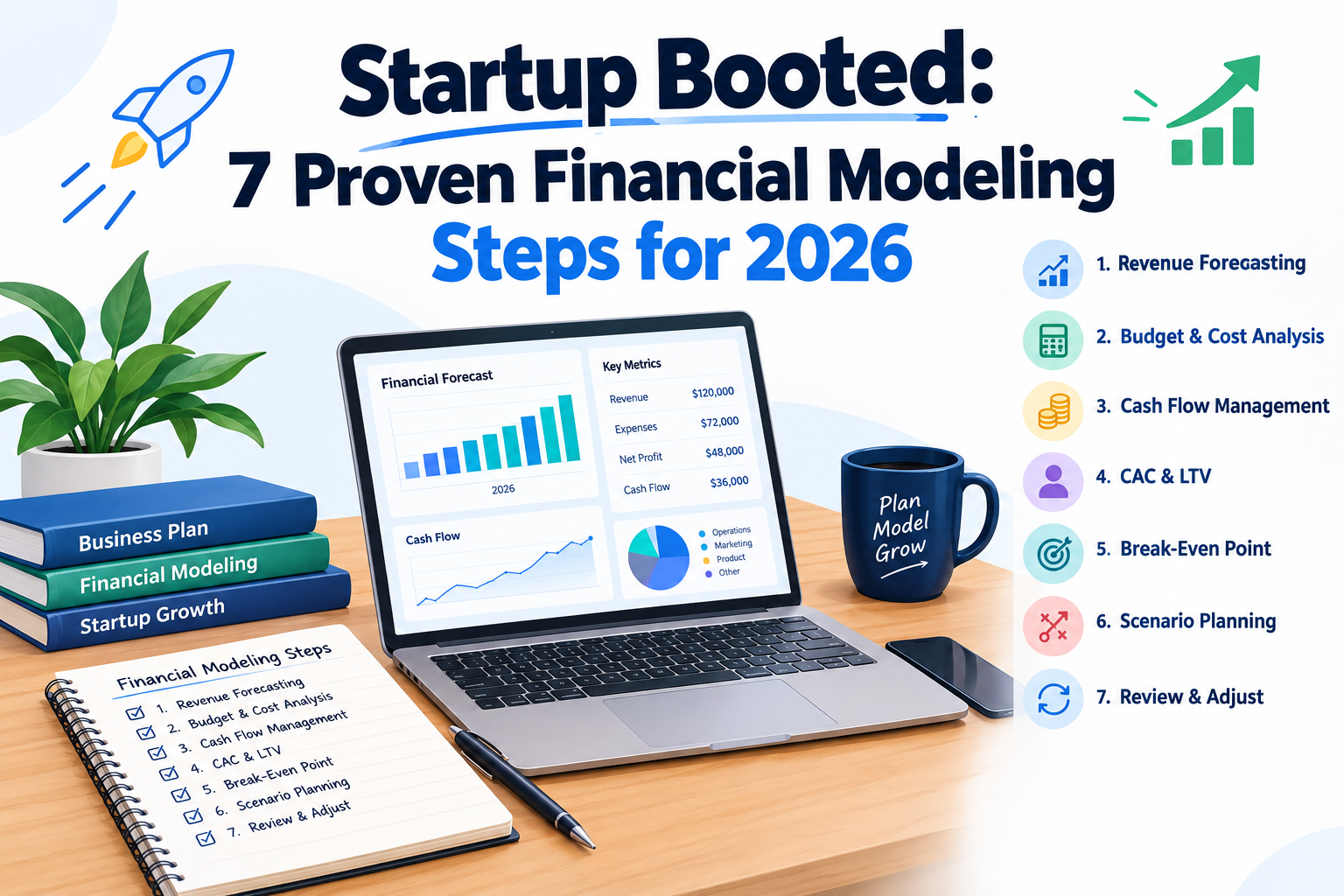
Startup Booted Financial Modeling in 7 Steps
Follow these steps in order. Each one takes an hour or less once you have your numbers.
Step 1: Define the Decision the Model Supports
Start with one question, such as “When do we become cash-flow positive?” or “Can we afford a first hire?” A model without a question becomes decoration.
Step 2: Put Every Assumption on One Input Sheet
List price, conversion rate, churn, hiring dates and fixed costs in one place. When an assumption changes, you edit one cell and the whole model updates.
Step 3: Forecast Revenue Bottom-Up
Build revenue from actions you control, such as leads, conversion rate and price. This is the heart of startup revenue forecasting, and it is covered in detail below.
Step 4: Separate Fixed and Variable Costs
Fixed costs stay the same each month, such as software, contractors and rent. Variable costs rise with sales, such as payment fees and hosting.
Step 5: Build the Cash Flow View
Revenue is not cash until the customer pays. Model when money arrives and leaves, not when you book it.
Step 6: Run Three Scenarios
Test a base case, a slow case and a fast case. The slow case tells you when to cut costs.
Step 7: Update Monthly Against Actuals
Compare the forecast with real results every month. The gaps teach you which assumptions were wrong.
Startup Revenue Forecasting: Bottom-Up vs Top-Down
Startup revenue forecasting has two main methods. Most early-stage founders should start bottom-up.
| Method | How it works | Best for | Weakness |
| Bottom-up | Leads × conversion rate × price, minus churn | Early-stage and booted companies | Needs real data to be accurate |
| Top-down | Market size × target share | Investor pitches and sanity checks | Easy to inflate, hard to defend |
A simple bottom-up formula looks like this:
- New customers = leads × conversion rate
- Customers this month = last month’s customers × (1 − churn) + new customers
- Revenue = customers × price
Use top-down only as a reality check. If your bottom-up plan needs a market share that looks impossible, the plan needs work.
Startup Budget and Cost Analysis: Fixed vs Variable
Startup budget and cost analysis shows where each dollar goes and which costs you can delay without hurting growth.
Sort every expense into three groups:
- Fixed: tools, contractors, subscriptions, rent.
- Variable: payment processing, hosting, support time per customer.
- Growth: ads, outreach, events, new hires.
Review a budget-vs-actual comparison every month. If marketing runs 20% over budget, ask whether the extra spend produced extra customers.
Gross margin is a useful health check. Gross margin is revenue minus the direct cost of serving customers, divided by revenue. A higher margin leaves more cash to fund growth.
Startup Cash Flow Management and Runway Rules
Startup cash flow management means tracking the cash that actually moves in and out so you never learn about a shortfall too late.
Runway is your cash divided by your monthly net burn. With $30,000 in the bank and a $3,000 monthly loss, you have about ten months.
These habits protect your runway:
- Check cash weekly when the runway drops below six months.
- Offer annual plans. Upfront payments improve cash without outside funding.
- Invoice fast and follow up on late payments.
- Set trigger points. Decide now what you will cut if the runway falls below six months.
- Keep a buffer equal to a few months of fixed costs.
Many founders also build a 13-week cash forecast. It looks only a quarter ahead, but it catches short-term gaps that a yearly model hides.
Worked Example: A 12-Month Startup Booted Financial Model
This example uses illustrative numbers, not real company data.
Assumptions:
- A software product priced at $60 per customer per month.
- Starting cash of $30,000.
- Fixed costs of $3,800 per month, plus variable costs of 12% of revenue.
- New customers start at 5 in month 1 and rise by 2 each month, reaching 27 in month 12.
- Monthly churn of 5%.
| Month | Customers | Revenue | Costs | Net | Cash at month end |
| 1 | 5 | $300 | $3,836 | -$3,536 | $26,464 |
| 3 | 20 | $1,210 | $3,945 | -$2,735 | $20,549 |
| 6 | 55 | $3,274 | $4,193 | -$919 | $15,821 |
| 8 | 84 | $5,064 | $4,408 | +$656 | $16,312 |
| 10 | 119 | $7,147 | $4,658 | +$2,489 | $20,343 |
| 12 | 158 | $9,495 | $4,939 | +$4,556 | $28,394 |
In the base case, monthly cash flow turns positive in month 8. Cash never falls below about $15,656, and the company ends the year with $28,394.
Now stress the plan:
| Scenario | New customers vs base | Lowest cash | Cash-flow positive from | Cash after 12 months |
| Slow | 50% of base | about $6,019 | month 12 | about $6,397 |
| Base | As above | about $15,656 | month 8 | about $28,394 |
| Fast | 130% of base | about $18,407 | month 7 | about $41,592 |
The slow case is the one to study. Cash gets thin and turns positive only at the very end, so a founder would cut costs early or extend the timeline.
Unit Economics: CAC, LTV and Payback
Unit economics show whether each customer is worth what it costs to win them.
- CAC (customer acquisition cost): sales and marketing spend divided by new customers.
- LTV (lifetime value): monthly revenue per customer × gross margin ÷ monthly churn.
- Payback period: CAC divided by monthly gross profit per customer.
Using the example above, gross margin is 88%. LTV is $60 × 0.88 ÷ 0.05, or about $1,056.
If CAC is $150, the LTV to CAC ratio is about 7 to 1. Payback takes roughly 2.8 months. A common rule of thumb is a ratio of at least 3 to 1, but treat it as a guide, not a law.
Financial Models for Startups: Tools Compared
You do not need expensive software on day one. Choose the tool that suit your stage.
| Tool type | Cost | Best for | Trade-off |
| Google Sheets or Excel | Free to low | Pre-seed and early revenue | Manual updates, risk of formula errors |
| Free templates | Free | A fast first draft | May not fit your business model |
| Dedicated forecasting software | Paid | Teams running many scenarios | Monthly cost and a learning curve |
| Accountant-built model | Highest | Fundraising or complex finances | Slower to change on your own |
Financial Planning for Entrepreneurs: When Outside Capital Makes Sense
Financial planning for entrepreneurs includes knowing when to raise money, not just how. Outside capital makes sense when you can say what it will buy.
Good signals to raise include:
- Revenue has grown predictably for several months.
- Churn is stable or falling.
- You have a channel that works and more money would scale it.
- Your runway is long enough to negotiate without pressure.
Common options include a SAFE, a convertible note, a priced equity round, a bank or SBA-backed loan, and revenue-based financing. Each trades cost, control and flexibility differently. Ask a startup lawyer to review any investment document.
6 Common Financial Modeling Mistakes to Avoid
- Modeling only the best case. Always include a slow scenario.
- Mixing up profit and cash. Late-paying customers can sink a profitable business.
- Ignoring churn. Growth that leaks is expensive growth.
- Never updating the model. A forecast is only useful when compared with reality.
- Raising before you have proof. Early money without traction often comes with worse terms.
- Copying a venture model. A booted company needs a cash-and-margin model, not a growth-at-all-costs one.
Your This-Week Checklist
- List your five key assumptions: price, conversion, churn, fixed costs and starting cash.
- Build a 12-month sheet with the three scenarios.
- Calculate your runway and set a trigger point.
- Compare last month’s budget with actual spending.
- Schedule a monthly 30-minute model update.
Conclusion
Startup booted comes down to one habit: let real numbers lead. Build a simple model, forecast revenue from actions you control, watch cash weekly, and test the slow case before it happens.
Do that, and you gain options. You can stay profitable and self-sufficient, or raise money later from a position of strength. This article is general education, not financial, tax or legal advice.
Frequently Asked Questions
What does startup booted mean?
Startup booted is an informal term for a revenue-first, bootstrapped-first approach where founders prove the business on customer revenue and raise outside capital selectively.
It is not a legal structure or a funding product, and it is different from any consulting company with a similar name.
What is startup booted financial modeling?
It is a monthly forecast of revenue, costs and cash that shows a self-funded startup how long its money lasts and which assumptions matter most.
How do you forecast revenue for a startup?
Start bottom-up: multiply leads by conversion rate, then by price, and subtract churn each month.
Use a top-down market estimate only as a sanity check.
How much runway does a startup need?
Many founders aim for 9 to 12 months or more of runway before negotiating with investors, though the right number depends on your burn rate and market.
What is a good LTV to CAC ratio?
A common rule of thumb is 3 to 1 or higher, but the right ratio depends on your business model, churn and growth stage.
Which tool is best for a startup financial model?
Google Sheets or Excel is the best starting point because it is free, flexible and easy to audit.
How often should you update a financial model?
Update it monthly with actual results, and check cash weekly when your runway is under six months.
Can a startup booted company still raise venture capital?
Yes, many founders raise later and on better terms once revenue, retention and unit economics give them leverage.