

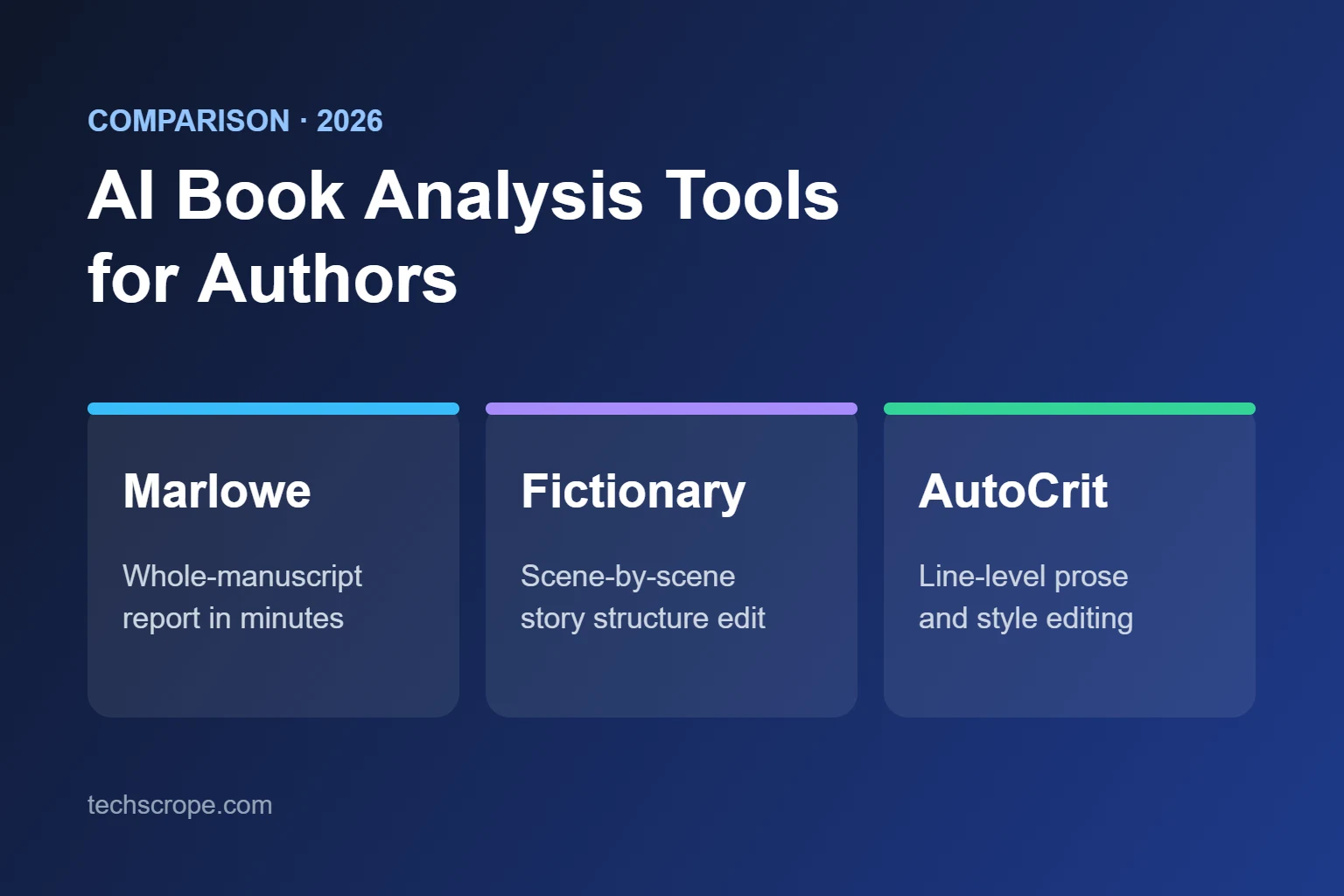
If you’ve finished a draft and can’t afford a developmental editor yet, AI book analysis tools can give you a structured second opinion in minutes. The three names authors ask about most are Marlowe (by Authors A.I.), Fictionary and AutoCrit. They sound similar, but they do quite different jobs.
Short answer: Marlowe gives you a fast, big-picture report on a finished novel. Fictionary walks you through a scene-by-scene structural edit. AutoCrit is a writing platform focused on line-level prose and style. Many authors use one for diagnosis and another for revision.
Prices and features checked on the official websites on November 21, 2026.
Marlowe vs Fictionary vs AutoCrit at a Glance
| Marlowe | Fictionary | AutoCrit | |
|---|---|---|---|
| Main job | Whole-manuscript report | Scene-by-scene story edit | Prose and style editing |
| Free option | Marlowe Basic, free and unlimited | 30-day free trial | Free plan with basic tools |
| Paid price | $29.95 per report, or $19.95/month (4 credits) | $49/month billed annually, or $66/month billed quarterly | $30/month, or $15/month billed annually |
| Best for | Seeing what’s working and what isn’t, quickly | Fixing structure, plot and character arcs | Tightening sentences, pacing and dialogue |
| Rewrites your text? | No | No, it gives feedback | No, it highlights issues |
Marlowe (Authors A.I.): A Fast Report on Your Whole Novel
Marlowe reads your complete manuscript and returns a report in a few minutes. It is an analysis tool, not a writing tool: Authors A.I. says Marlowe never rewrites the text of your book. Instead, it compares your manuscript with top titles in 22 fiction genres and subgenres.
What you get: The free Basic report covers about half a dozen areas, such as dialogue versus narrative, sentence statistics, clichés and repeated phrases. The Pro report adds the big-picture analysis most authors want: plot and character, pacing and structure, dialogue and voice, a revision checklist and an overall assessment.
Pricing:
- Marlowe Basic: free, unlimited reports
- Single Pro report: $29.95
- Monthly plan: $19.95/month with four report credits
- Annual plan: $159/year with 48 credits
There’s also a separate Market Fit report ($29.95 on its own) that drafts marketing copy such as a book description and pitch.
Good to know: Upload a Word (.docx) or .epub file. Marlowe isn’t designed for manuscripts under 10,000 words, and it doesn’t work well with anthologies or several books combined into one file. Authors A.I. says manuscripts are encrypted, never used for AI training and not added to its comparison data. Its pages aren’t consistent about refunds, so check the current terms before you pay.
Choose Marlowe if you have a complete draft and want a quick, affordable diagnosis before you decide where to spend your revision time.
Fictionary: A Guided Structural Edit, Scene by Scene
Fictionary is built around story structure rather than sentences. When you import your manuscript, it automatically draws a Story Arc so you can see where your key plot points land compared with the shape of successful commercial fiction. You then work through each scene using the 38 Fictionary Story Elements, which cover plot, character and setting.
Fictionary also includes an AI editor called Edwina, which gives feedback on every scene. The bigger difference from the other two tools is the human side: the membership includes weekly live classes taught by certified editors, writing courses, a community and an “Ask an Editor” option.
Pricing: Fictionary’s pricing page now lists one membership that includes StoryTeller Premium software:
- $49/month billed annually ($588/year)
- $66/month billed quarterly ($198 every three months)
- 30-day free trial on both
Older reviews quote lower prices for a software-only StoryTeller plan. That option isn’t shown on the pricing page at the moment, so go by the official page when you compare.
Choose Fictionary if your draft has structural problems, such as a saggy middle, a weak midpoint or scenes that don’t move the story, and you want to learn how to fix them yourself.
AutoCrit: Line-Level Editing in a Writing Platform
AutoCrit is a full writing platform where you can plan, write and edit in one place. Its strength is the prose itself: it flags issues with pacing, dialogue, word choice and “strong writing,” and scores your text against publishing standards and selected genres.
What you get: The free plan has no word limit and includes the editor plus a few tools, such as Adverbs, Word Choice and Readability. AutoCrit Pro adds a summary report with an AutoCrit Score, comparisons with genres and selected authors, more than 25 editing tools, the Story Analyzer, automated alpha and beta readers, ePub and PDF export, and a member community.
Pricing:
- Free: $0
- Pro Monthly: $30/month
- Pro Annual: $15/month, billed once a year
Choose AutoCrit if your story is in good shape and you now want to tighten sentences, repetition and dialogue chapter by chapter.
Which AI Book Analysis Tool Should You Choose?
- On a tight budget: Start with Marlowe Basic and AutoCrit Free. Both cost nothing and will show you whether this kind of feedback helps you.
- You just finished your first full draft: A single Marlowe Pro report ($29.95) is the cheapest way to see the big picture before you revise.
- Your plot or structure feels off: Fictionary, ideally during its free trial, so you can finish one structural pass before deciding to pay.
- You’re polishing a later draft: AutoCrit Pro, especially on the annual plan.
- A common combination: Marlowe to find the problems, Fictionary or AutoCrit to fix them.
How to Get Useful Feedback From AI Book Analysis Tools
- Analyze a complete draft. Big-picture reports on pacing and arcs only make sense when the whole story is there.
- Treat genre comparisons as signals, not rules. Being “different from bestsellers” can be a strength. Look for patterns, not single numbers.
- Revise, then re-run. The value is in comparing reports before and after a revision.
- Keep humans in the loop. These tools are a good first pass, but beta readers and, when you can afford one, a human editor still catch what software can’t.
- Read the privacy terms. Check how each service stores your manuscript before you upload unpublished work.
Frequently Asked Questions
Are AI book analysis tools worth it?
They’re worth it as a fast, low-cost first read, especially before you pay for a human edit. They can’t judge whether your story is moving or original, so use them to find problems, not to decide if your book is good.
Which of these tools is free?
Marlowe Basic and AutoCrit’s free plan are free with no time limit. Fictionary offers a 30-day free trial.
Will these tools rewrite my book?
No. Authors A.I. says Marlowe never rewrites your text, and Fictionary and AutoCrit point out issues for you to fix. The writing stays yours.
Is my manuscript used to train AI?
Authors A.I. states that manuscripts uploaded to Marlowe are never used for training. For Fictionary and AutoCrit, read their current privacy policies before uploading.
Do they work for nonfiction?
All three are built mainly for fiction. Marlowe says it can handle long narrative work such as memoir, but its genre comparisons are for fiction.
Sources
- Authors A.I.: Marlowe FAQ and pricing
- Fictionary: Pricing
- Fictionary: StoryTeller products
- AutoCrit: Pricing
Related Guides
- InferKit Review and the Best Alternatives
- ChatGPT vs Local AI Models: How Privacy Differs
- 10 Best Free AI Tools for Students in 2026