AI consulting firm red flags are warning signs in a firm’s pitch, team, pricing or contract that mention it is better at winning work than delivering results. Spotting them before you sign can save you months of wasted budget.
The market is crowded. Almost every agency now sells “AI transformation,” and quality varies wildly. According to IBM’s 2025 CEO study, only about 25% of AI initiatives delivered their expected ROI. Gartner also predicted that 30% of generative AI projects would be abandoned after proof of concept by the end of 2025.
Many of those losses trace back to the partner, not the technology. This guide gives you a scored AI consulting red flags checklist, the questions that expose weak firms, and a due diligence process you can run in under two weeks.
Quick Summary: The 12 Red Flags at a Glance
- In the sales call: demo before diagnosis, guaranteed results, pressure to sign, unverifiable claims
- In the team and plan: bait-and-switch staffing, no definition of “done,” no adoption plan
- In the money: hidden fees, lock-in, undisclosed commissions
- In the risk: vague data handling, no human oversight
One flag deserves a hard question. Four or more is a reason to walk away.
What Are AI Consulting Firm Red Flags?
They are patterns that show a firm is optimized for selling, not delivering. Some are behavioral (pressure tactics), some are structural (junior teams), and some are contractual (no exit clause).
Not every flag is a deal-breaker. A young firm may have few case studies, and a commission is fine once disclosed. What matters is how the firm answers when you ask.
AI Consultant Warning Signs in the Sales Conversation
The first call reveals the most. Nothing is written down yet, so the firm shows how it really works.
1. They Demo Before They Diagnose
A credible firm starts with questions about your processes and data, not a flashy demo. A demo-first pitch means the solution was built before your problem was understood.
Ask: “What would you need to learn about our operations before recommending a starting point?” A strong answer covers your data, workflows, error rates and systems. A weak answer jumps to tools.
2. They Guarantee Savings or ROI Upfront
No honest consultant can promise a specific saving before measuring your volumes and costs. A number quoted in the first call is marketing, not analysis.
Look for estimates built from your own figures, with assumptions written down. Past results are fine if they are clearly labeled as past results, not promises for your business.
3. They Use Pressure and Fear
Artificial deadlines and “your competitors are already ahead” messaging are tactics to skip your due diligence. Real consultants can explain what changes if you start in two months instead of now.
4. Their Claims Can’t Be Verified
Credible firms name clients, give metrics and let you speak to someone whose project is live. Treat these as warnings:
- “Proprietary AI” that is a thin layer over a public model
- Case studies with no named sector, metric or date
- Outdated technical claims presented as current
A new firm with few references can still be fine if it offers a small paid pilot so you can judge the work directly.
AI Vendor Red Flags: Team, Scope and Delivery
5. The Pitch Team Isn’t the Delivery Team
If senior partners sell the deal and juniors do the work, quality drops after signing. Ask who will work on your project and what percentage of their time you get.
Request profiles for the delivery team. Require written approval for key personnel changes.
6. They Can’t Define “Done”
Without acceptance criteria, scope drifts and disagreements become opinion battles. Insist on a written definition: the metric to improve, the production threshold, and the timeline.
A good criterion sounds like this: “Accepted when the system handles 90% of test cases correctly and flags the rest to a person.”
7. No Change Management Plan
Technically successful pilots often fail because nobody adopts them. Ask for a named adoption approach covering role changes, manager training and feedback loops.
“We include a training session” is not a plan.
AI Consulting Hidden Fees and Pricing Red Flags
8. The Quote Hides Real Costs
Many proposals price the build and stay silent on what you pay after launch. AI systems carry ongoing costs that surprise buyers who only compare build fees.
Use this table to find the gaps in any quote:
| Cost Area | Question to Ask |
| Discovery | Is it paid? What do I keep afterward? |
| Data preparation | Who cleans and structures our data, and at what rate? |
| Integration | Are connectors to our existing systems included? |
| Model and API usage | What is the monthly usage cost at our volume and at double it? |
| Software licenses | Which subscriptions are required, and who pays? |
| Change requests | How are scope changes priced? |
| Support retainer | Is it optional, and what exactly does it cover? |
| Exit and handover | Is there a fee to transfer documentation and access? |
A good proposal states assumptions and gives a range. It does not leave whole categories blank.
AI Vendor Lock-In: Red Flags That Trap You
9. Everything Lives in Their Accounts
If automations, API keys and data sit in the consultant’s accounts, you can’t leave without rebuilding. If they stop paying or you part ways, your workflows can stop overnight.
Lock-in usually shows up in four places:
- Accounts: built in the vendor’s cloud or automation workspace
- IP: the contract doesn’t assign code, prompts and models to you
- Data: no export path or portability guarantee
- Support: a “monthly retainer” is the only way anything keeps running
Ask: “Can you build in accounts we own, with you added as a user?” Also confirm a handover list covering workflows, prompts, a runbook and cost details, so another team could take over.
10. Undisclosed Commissions and Referral Fees
Many software vendors pay referral commissions, and a hidden commission can tilt advice toward the wrong tool. Partner status is fine. Concealing it is the red flag.
Ask directly: “Do you receive any payment, discount or credit from the tools you recommend?” An honest “yes, and here’s why I still recommend it” is a good sign.
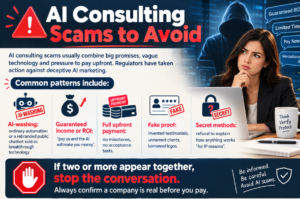
AI Consulting Scams to Avoid
AI consulting scams usually combine big promises, vague technology and pressure to pay upfront. Regulators have taken action against deceptive AI marketing.
Common patterns include:
- AI-washing: ordinary automation or a rebranded public chatbot sold as breakthrough technology
- Guaranteed income or ROI: “pay us and the AI will make you money”
- Full upfront payment: no milestones, no acceptance tests
- Fake proof: invented testimonials, unnamed clients, borrowed logos
- Secret methods: refusal to explain how anything works “for IP reasons”
If two or more appear together, stop the conversation. Always confirm a company is real before you pay.
Risk and Compliance Red Flags
11. Vague Answers About Data Security
A trustworthy firm can draw, on one page, where your data goes and which services store a copy. “It’s all secure and encrypted” is not an answer.
Ask whether your data is used to train any model, which plan tier is used, and who can access logs. If the answer is “I’ll confirm the vendor’s current terms in writing,” that is a good sign, since terms change often.
12. Customer-Facing AI With No Human Check
Unchecked AI replies create legal and reputational risk. A bot that invents a refund policy can leave you with a dispute and a bad review.
Ask what customers see when the AI is unsure and who gets alerted. If you serve EU customers, check chatbot transparency duties under the EU AI Act.
AI Consulting Red Flags Checklist: Score Any Firm in 5 Minutes
Count how many of the 12 flags you’ve seen:
| Flags Found | What to Do |
| 0–1 | Proceed, and put their answers in the contract |
| 2–3 | Pause and get written answers to every flagged item |
| 4+ | Walk away |
Weigh the quality of replies, not just the count. A firm that answers a flagged question clearly and in writing is safer than one that dodges.
Green Flags: Signs a Firm Is the Real Deal
Strong firms behave in the opposite way on every flag above. Look for:
- A paid, structured discovery phase that ends with a written output you keep
- Estimates built from your own numbers
- Named team members and time allocations
- Willingness to say “I don’t know, I’ll check” or “you don’t need AI for this”
- Work built in your accounts, with a documented handover
- References who can say the system is live and who maintained it
Some signs look bad but are often fine: charging for discovery, declining a fixed price on call one, or recommending a cheaper tool you already own.
AI Consulting Due Diligence: A 10-Day Process
Due diligence takes about two weeks and consists of five checks. Run them on every shortlisted firm:
- Ask for a diagnostic workshop before any proposal.
- Check named products in the proposal against the vendors’ own pages to catch retired or renamed tools.
- Request one redacted project document, such as a runbook or test sheet.
- Call references at the operations level. Ask: “Did it reach production, and could you run it after they left?”
- Start with a scoped pilot before any multi-year commitment.
Prepare your own side first by reviewing your data and processes before you meet any firm.
AI Consulting Due Diligence Red Flags in the Contract
Your contract should turn every answer you received into an obligation. At minimum, confirm these clauses:
- Deliverables and acceptance tests tied to measurable thresholds
- IP assignment of code, prompts, models and documentation to you
- Key personnel with approval rights over replacements
- Milestone-based payments, with part of the fee linked to outcomes
- Data protection terms covering storage, training use and deletion
- Termination and handover with no punitive exit fees
- Remediation process if milestones are missed
Refusal to explain outcome-linked fees isn’t always a deal-breaker, but it tells you how confident the firm is in its own delivery.
Final Thoughts
AI consulting firm red flags are rarely hidden. They show up in the first call, the proposal and the contract, if you know what to ask. Use the checklist, insist on written answers, and own your accounts, data and documentation from day one.
The best firms welcome tough questions because it separates them from the competition. If a firm dodges, you’ve learned what you need to know.
Frequently Asked Questions About AI Consulting Firm Red Flags
What are the biggest AI consulting firm red flags?
The biggest red flags are guaranteed results before analysis, demos before diagnosis, a pitch team that differs from the delivery team, missing running costs, work built in the consultant’s accounts, and vague answers about data handling.
How do I spot AI consulting scams?
Watch for AI-washing, guaranteed ROI, full upfront payment, unverifiable testimonials and refusal to explain how the system works, and walk away if two or more appear together.
What are the hidden fees in AI consulting?
Common hidden fees include paid discovery, data preparation, system integration, model and API usage, software licenses, change requests, support retainers and exit or handover charges.
How can I avoid AI vendor lock-in?
Build in accounts you own, require IP assignment in the contract, secure data export rights, and demand a handover package so another team can maintain the system.
What should be in an AI consulting red flags checklist?
A solid checklist covers sales behavior, team transparency, success criteria, change management, full cost disclosure, account and IP ownership, commission disclosure, data security and human oversight.
How long does AI consulting due diligence take?
A thorough due diligence process typically takes one to two weeks for smaller projects and three to four weeks for large enterprise engagements.
Is a high price a sign of a good AI consultant?
No, price alone says nothing about quality, so judge firms on evidence of delivery, transparency and contract terms instead.
Should I start with a pilot before a full AI consulting contract?
Yes, a short paid pilot with clear deliverables lets you test the firm’s skill, communication and honesty before committing a larger budget.